Long Island
Dean's Blue Hole, Long Island
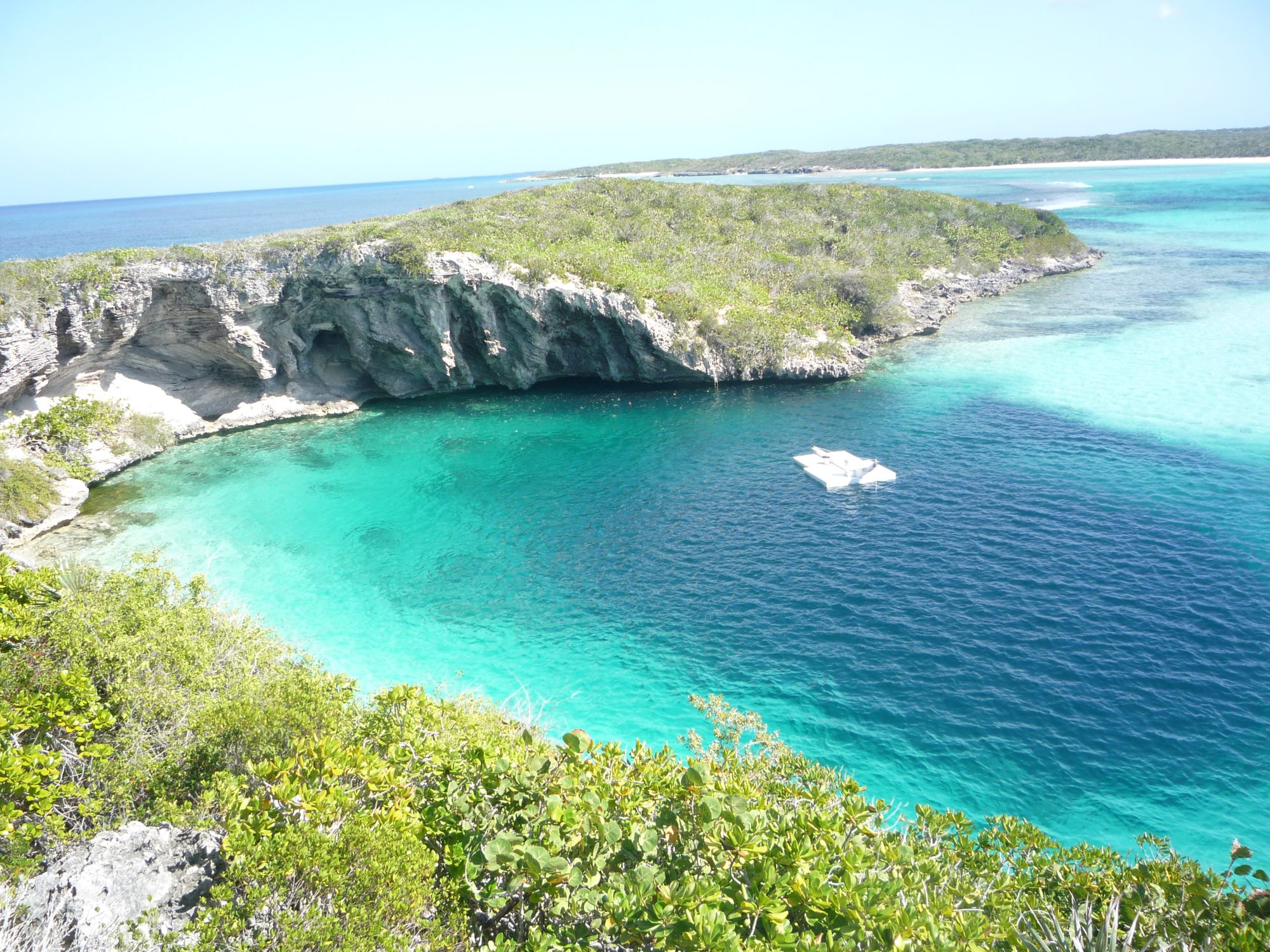
A blue hole about 200 m deep in a small cove near Clarence Town, with cliffs on three sides, a beach on the fourth, and deep water one step off the sand.
The short answer
Dean’s Blue Hole is a deep, water-filled sinkhole in a small cove on Long Island, Bahamas, west of Clarence Town. The only survey of it, in 1994, measured 202 m (663 ft). It was the deepest known blue hole until 2016 and is now ranked third, behind Dragon Hole in the South China Sea and Taam Ja’ in Mexico.
Cliffs wrap around three sides of the cove and a white-sand beach forms the fourth, so you can swim from the sand straight out over the hole. The shallows end at the rim without warning, and people have drowned there. It is also the home of Vertical Blue, a freediving competition held there since 2008.
Getting there
You drive. An unpaved track off the main road ends at a small parking area just behind the beach, a short walk from the hole. The Vertical Blue freediving school puts it 5 to 10 minutes from Deadman’s Cay and about an hour’s drive from Stella Maris, and says visitors need a rental car because lodging, restaurants and shops are spread out.
Deadman’s Cay airport has been closed for rebuilding since January 2026, so flights to Long Island now land at Stella Maris in the north. Plan on that hour’s drive south. Getting there.
What it’s like
The hole sits in a cove with rock cliffs on three sides and a white-sand beach and turquoise lagoon on the fourth. Its opening is a few dozen meters across at the surface; published figures range from about 30 m to 55 m depending on where it’s measured. Below, it widens into a cavern about 100 m across.
The water inside is usually calm and sheltered from swell and current. Visibility runs about 10 to 50 m, and in July the water is about 28 to 29 C, with no cold layer below. Light fades fast: by about 60 m it is getting dark. A school of tarpon lives at about 20 m, and sea turtles sometimes come in to rest.
It is a popular local spot for swimming and diving, including off its cliffs, and we found no rules restricting either. We found no information on an entry fee or facilities, so bring water and shade.
Safety
The sandy shallows end at the rim without warning. In July 2008 a woman wading in the shallows stepped into the hole, and she and two people who tried to help her, one a 14-year-old girl, drowned. In 2012 police said there were no warning signs at the hole; we found no later report that any were put up.
Other deaths in dated news reports:
- May 2012: Theron Maillis, 19, of Clarence Town, failed to surface while diving with friends.
- November 2013: freediver Nicholas Mevoli, 32, died after a 72 m dive at Vertical Blue; AIDA, which sanctioned the event, said he appeared to have suffered a depth-related lung injury.
- August 2024: Douglas McHardy, 50, drowned; his body was found about 600 feet down with an underwater drone.
Keep children and weak swimmers well back from the edge of the shallows, and never dive deep without a trained partner. Local lore has long treated the hole as a place to avoid; some call it a portal to hell.
How deep is it?
William Wilson’s 1994 survey, the only one we found, put Dean’s Blue Hole at 202 m (663 ft); the Vertical Blue school uses 203 m. It was the deepest known blue hole until July 2016, when Chinese researchers reported Dragon Hole in the South China Sea at 300.89 m. In December 2023 cable casts in Mexico’s Taam Ja’ blue hole reached at least 420 m without finding the bottom, pushing Dean’s to third.
How it formed is still an open question. At the last ice-age low, about 20,000 years ago, the sea stood more than 120 m below today’s level, yet the hole goes down about 200 m. A 2017 University of Geneva thesis used its walls to study Long Island’s rock layers, and in June 2024 Blue Marble Exploration, a company led by OceanGate co-founder Guillermo Sohnlein, announced plans to survey the bottom for the first time. We found no report that it has.
Freediving and Vertical Blue
Sebastien Murat, then at the Stella Maris dive center, first pointed freedivers to the hole. William Trubridge says he first dived it in 2005, and he set his first world record there in April 2007: 81 m without fins.
Trubridge started Vertical Blue at the hole in April 2008 with 16 invited freedivers, and it has been held most years since. The hole hosted the 2009 AIDA individual depth world championships, and Trubridge set more records there, including the first dive past 300 feet without fins, 92 m in April 2010, and 102 m in July 2016, a record that stood until May 2025. Vertical Blue counts 75 world records set at the hole across its competitions. The only current open world depth record set there is Alenka Artnik’s 123 m with a monofin, from July 2025.
The event ran under AIDA rules until 2020 and under CMAS rules from 2021. It skipped 2024, when Trubridge cited poor roads, frequent utility outages and too few flights, returned in July 2025 with 17 divers from 16 countries, and ran again on 20-30 June 2026 as a CMAS World Cup event. The Vertical Blue school still teaches at the hole and has published a course calendar for February to May 2027.
Who owns it?
In January 2013 the head of the Bahamas National Trust said the hole itself is seabed owned by the government, while the land around it was private; about 30 acres around the hole were then listed for $10 million. Ministers said the site would stay in Bahamian hands, but it had no protected status. We found nothing newer on who owns the land.
No reliable source says who Dean was. Accounts range from a Bahamian fisherman to a local landowning family.
Where to stay nearby
Gems at Paradise, near Clarence Town, is the closest lodge we could confirm open for 2026. Coconut Bay’s villas at Pinder’s and Cape Santa Maria at the north end are farther. Places to stay on Long Island.
Dean's Blue Hole map
Questions visitors ask
How deep is Dean’s Blue Hole?
About 202 m (663 ft), from a 1994 survey, the only one we found. It is now ranked the third-deepest known blue hole in the world.
Can you swim in Dean’s Blue Hole?
Yes. Swimming and snorkeling from the beach are popular and we found no rules against them. The shallows end at the rim without warning, so keep children and weak swimmers well back from the edge.
Is Dean’s Blue Hole dangerous?
It can be. Three people drowned there in 2008 after one stepped off the edge of the shallows, and there have been other deaths since; the most recent we found was in August 2024. In 2012 police said there were no warning signs.
How do you get to Dean’s Blue Hole?
By car. It’s west of Clarence Town, down an unpaved track off the main road, about an hour’s drive from Stella Maris airport, where Long Island flights land while Deadman’s Cay airport is rebuilt.
Is Dean’s Blue Hole the deepest in the world?
Not anymore. It held the title until 2016. Dragon Hole in the South China Sea (about 301 m) and Taam Ja’ in Mexico (at least 420 m) are deeper.
What is Vertical Blue?
A freediving competition held at Dean’s Blue Hole since 2008, founded by William Trubridge. It most recently ran in June 2026.
Keep exploring
Sources and how we list
History and island facts come from the sources below, with primary and scholarly sources preferred over secondary ones. Last checked November 2026. How we list.
Sources (22)
- www.deansbluehole.com
- www.verticalblue.net
- www.verticalblue.net
- www.tribune242.com
- www.tribune242.com
- www.tribune242.com
- www.thenassauguardian.com
- www.tribune242.com
- www.ksl.com
- www.williamtrubridge.com
- www.deeperblue.com
- archive.verticalblue.net
- www.deeperblue.com
- www.molchanovs.com
- events.verticalblue.net
- www.cbsnews.com
- www.frontiersin.org
- archive-ouverte.unige.ch
- www.scrippsnews.com
- www.aol.com
- en.wikipedia.org
- www.popularmechanics.com